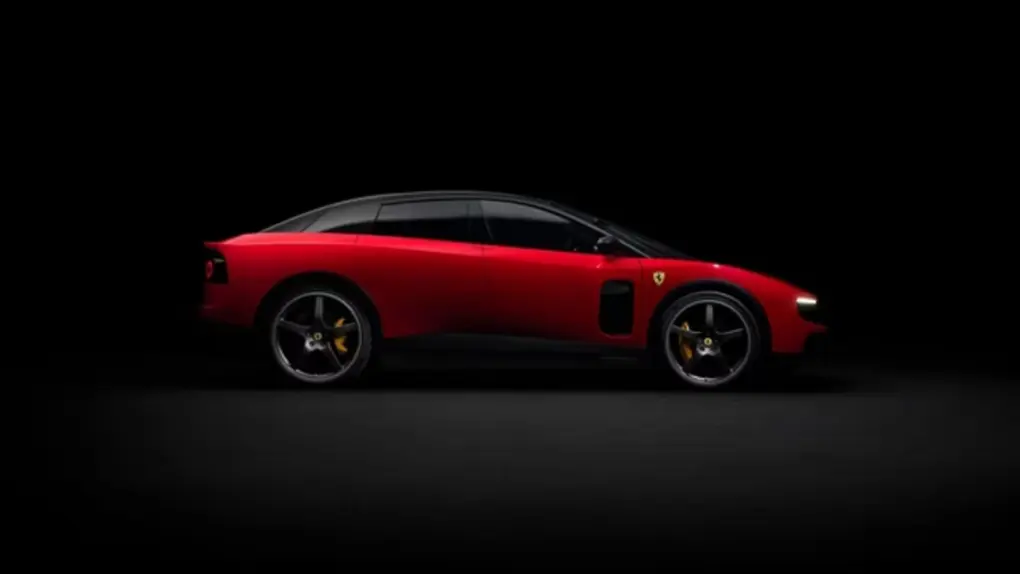
Ferrari officially pulled the wraps off the Luce, its first-ever all-electric vehicle, on Monday — and for Apple fans, this one’s personal. The car’s exterior and interior took design cues from LoveFrom, the creative collective founded by former Apple design chief Jony Ive and longtime collaborator Marc Newson.
The Ferrari Luce is the highest-profile project the duo has taken on since leaving Cupertino, and it’s already dividing opinions. Plus, it’s the closest we’ll ever get to an Apple car.
Jony Ive’s Ferrari Luce design unveiled
The Ferrari Luce unveiling took place in Rome, capping a slow-burn reveal that began with specs last October and continued in February with a first glimpse at the interior. What the world finally got to see via Ferrari’s display and press release this week gave the full picture: a striking, polarizing, deeply considered vehicle that may be the closest thing we’ll ever get to the Apple car that never was.
Of course, folks on social media are already having fun ripping on the car’s design through various memes. Newson, by the way, also designed the Ford 021C (“21st century”) concept car shown at the 1999 Tokyo Motor Show.
A design that divides opinions
— bel (@bel3zc) May 26, 2026
If you’re expecting the Luce to look like a Ferrari, prepare yourself. The first time you see the new electric vehicle, it takes a few seconds to register that you’re looking at a Ferrari. If it weren’t for the Prancing Horse badge and the unmistakable Rosso Corsa paint option, you might not think of the legendary Italian automaker, Electrek reported from Rome.
The car is Ferrari’s first five-seater and its first sedan. It’s also the first Ferrari co-designed by LoveFrom, and notably the first vehicle of any kind the San Francisco-based studio has designed.
This pretty much nails the abomination that is the Ferrari Luce $AAPL $RACE $TSLA pic.twitter.com/9FxMFHJHip
— Bruce (@SPXplays) May 26, 2026
An S-duct, a feature borrowed from Ferrari’s racing DNA, dominates the front end. Beyond its aerodynamic function, it creates a visual trick: The black indentation housing the air intake and headlights creates an illusion that makes the front overhang appear much shorter than it actually is. That black element flows uninterrupted from the hood to the rear, creating a two-tone design language across the entire length of the car.
Left, Ferrari Luce $645k
Right, Nissan Leaf $35k pic.twitter.com/2PtrCrgnDW— Tommy (@_TommyMason) May 25, 2026
Apple-watchers have noted that the aesthetic has more in common with 21st-century tech design than a traditional supercar. The exterior offers stylistic cues reminiscent of early-2000s computer peripherals — curved forms with black surfaces.
AppleInsider went further, suggesting the vehicle gives us an idea of what the scrapped Apple car project may have looked like under Jony Ive‘s direction.
LoveFrom truly shines in the cockpit
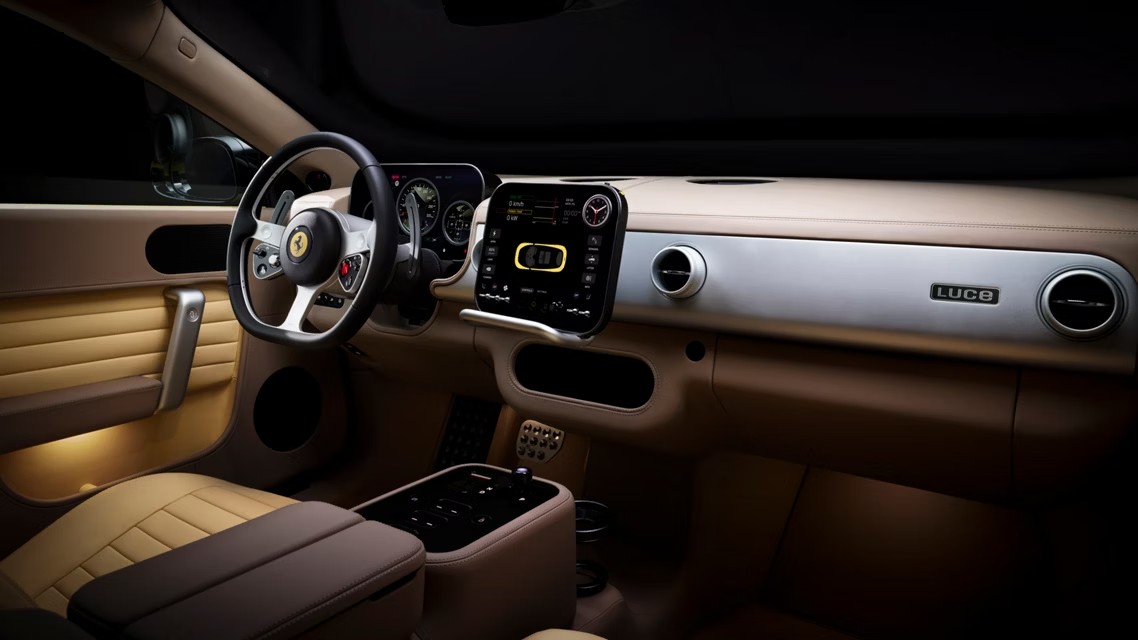
Photo: Ferrari
Whatever you think of the Ferrari Luce’s exterior, the interior is a different story — and it’s the part that will probably mean the most to Apple fans.
Every interaction point, every knob, every toggle and every fan control is clean, minimalist and deeply satisfying to use, according to reviewers. Ferrari machined most of the parts from single pieces of metal.
The Luce’s steering wheel alone is remarkable. Ferrari machined the three-spoke design from 100% recycled aluminum. With an anodized finish, glass elements and leather grip, the steering wheel houses the binnacle, torque-control paddles, and Ferrari’s iconic manettino dial — all moving together as one assembly.
Samsung developed the Luce’s custom OLED displays. An E Ink car key changes color when docked. Mechanical dials are encased in precision-machined aluminum housing. Every element suggests a team that obsessed over details in a way rarely seen.
Where most design studios might have defaulted to larger screens and digital interfaces following industry convention, LoveFrom pushed back. The result is a cockpit that feels like the anti-Tesla — an anti-touchscreen statement — but without abandoning touch interfaces entirely where they genuinely serve the driving experience.
Ferrari described the approach succinctly. The Luce’s singular design language unites the exterior, interior and interface with clarity and refined simplicity throughout.
The numbers behind the design
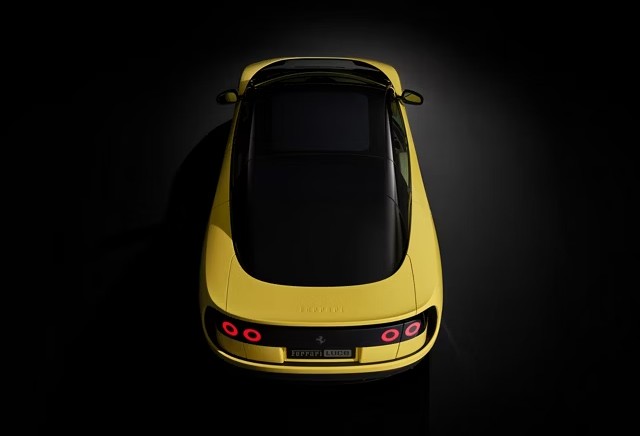
Photo: Ferrari
The Luce isn’t just a pretty face (for those who would give it that much credit). The four-door, five-seat car is powered by four electric motors providing up to 1,035 horsepower, equipped with a high-capacity 122 kWh battery. Ferrari says it can accelerate from zero to 100 km/h (62.14 mph) in just 2.5 seconds.
The top speed is 310 km/h (192.6 mph), the zero to 200 km/h (124.27 mph) sprint takes 6.8 seconds, and the range exceeds 530 km (329 miles). The 800V architecture supports fast charging up to 350 kW.
Ferrari’s new Vehicle Control Unit manages all four motors independently, updating actuation targets 200 times per second. Each wheel gets independent torque vectoring, active suspension control, and, on the rear axle, independent steering. The project includes more than 60 new patents.
Perhaps most intriguing for audiophiles is how Ferrari tackled the absence of an engine note. A precision accelerometer mounted at the center of the rear axle captures the actual vibration of the rotating electric components. That signal is filtered, equalized and amplified — working like an electric guitar’s amplifier.
The result is a sound rooted in the real physics of the machinery, not synthesized from a speaker library. Ferrari spent five years and 40,000 km of dedicated testing developing the Luce’s unique sound.
What this means for the Apple faithful
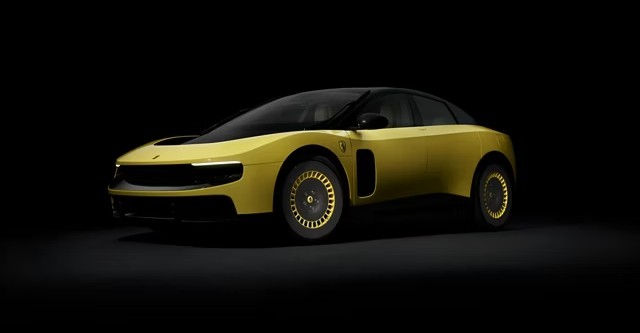
Photo: Ferrari
The Ferrari Luce is the most tangible expression yet of what Jony Ive’s design sensibility looks like when applied to something with four wheels. The reveal offers a new look at a cockpit shaped around glass, aluminum and Ive’s distinctive, minimalist approach, with an emphasis on physical controls over touchscreens.
For those who mourned the Apple car’s cancellation in 2024, this is as close as it gets. Ferrari’s executive chairman John Elkann framed the Luce’s creation as a proactive choice rather than an industry concession. Ferrari is “not going electric as a response to change, but as a decision to lead what comes next,” he said.
Pricing starts at 550,000 euros ($640,000), with production set to begin in late 2026. The car will launch in the United States in the second quarter of 2027.
Whether or not it looks like a Ferrari, the Luce is unquestionably a product of the same design philosophy that gave us the iMac, the original iPod and the iPhone. Whether that’s a reason to be excited or nervous probably depends on which side of the Prancing Horse you sit on.

David Snow, an expert on Apple hardware and software, writes on a variety of technological and cultural topics for Cult of Mac. They include Apple news, technology buying guides, and features about computer setups and Apple TV shows and movies.
With 30 years of experience covering technology and other subjects, he has written and edited for numerous print and online publications, including CMP Media, TechTV.com, CNET, Wired News, Red Herring magazine, Law.com, The National Law Journal and Law Technology News magazine. Among other roles, he served as executive editor of the Law.com network of websites and editorial director, technology, for ALM Media.
Snow graduated with a B.A. from Syracuse University with majors in magazine journalism and psychology. While there, he worked as a reporter for The Daily Orange newspaper and associate editor of Equal Time magazine.
Founder of the blog At the Waterline, he can be reached on X (formerly Twitter) via @atthewaterline and on Mastodon via @dsnow.

